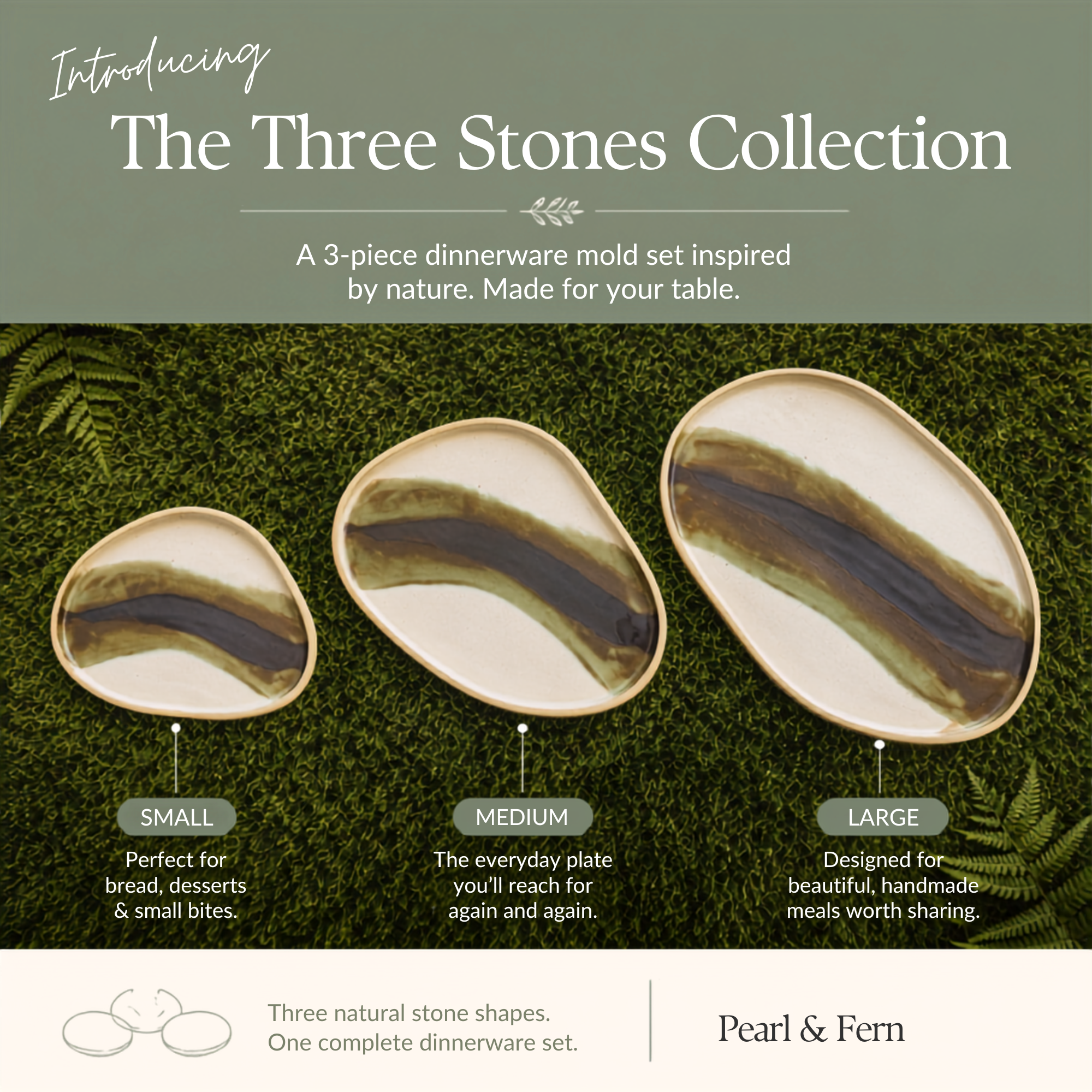
The 3 Stone Origin Story
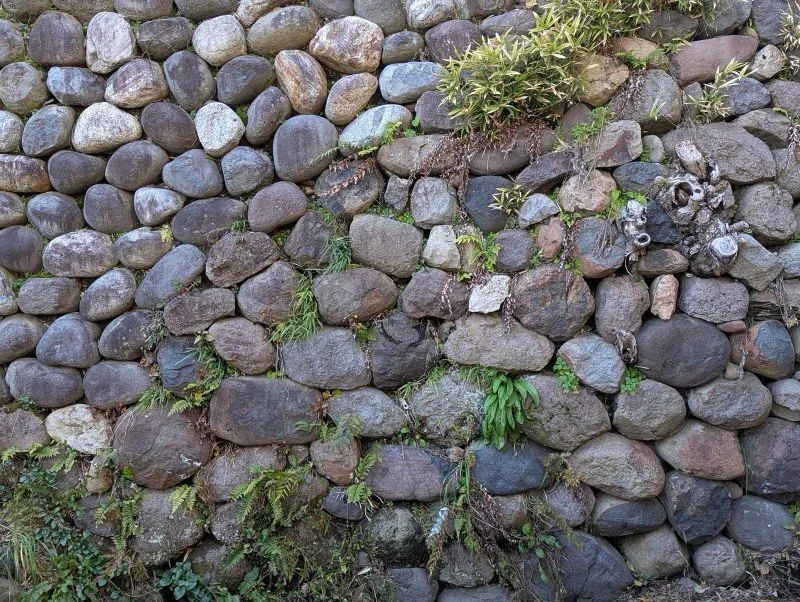
In December 2025, on a walk through Kanazawa, we stopped at a small roadside nook near the Hashiba intersection, where a low wall of river stones runs along the street. A wooden sign explained what we were looking at: the remains of Kanazawa Castle's sōgamae, the moats and earthen ramparts that ringed the castle town from 1599.
This particular stretch sits at Karekibashi, the "withered tree bridge," named for nothing more than a dead tree that once stood beside it. For centuries this was the eastern gate of the city. The wall standing today was restored in 2008 after excavations uncovered the Edo-period stonework beneath the modern street. The city still tends this place, four hundred years on.
We photographed the wall simply because it was beautiful: hundreds of rounded stones, no two alike, packed together with ferns and moss growing in the gaps. Back home in the studio, we picked three of those stones and traced their outlines, full size, from the photograph. Those three tracings became the rims of the three dishes in this collection.
So when we say the shapes are natural, we mean it literally. Nobody designed these outlines - not even us. A river in Ishikawa Prefecture tumbled these stones into shape, masons stacked them into a wall, and we just borrowed the silhouettes.
Where the shapes come from
Each mold in the Three Stones Collection is a flat forming mold (a drape mold) for making a shallow dish. The surface is flat through the middle and curves gently down toward the rim, and the outline is the traced stone.
Each mold pairs with a matching stand - a cylinder that inserts into the underside of the mold and lifts it off the table. With the mold raised, you lay a slab over the form, let the edges drape past the rim, and trim them cleanly where they fall. The stand's sides curve inward between top and bottom; we like how it looks, and the waisted profile also makes it noticeably more durable than a straight tube.
The result is a dish with a quiet, irregular rim - the kind of outline you'd never draw freehand, because hands want symmetry and rivers don't.
What the molds are
The aesthetic that drew us to that wall has a name in Japan: wabi-sabi, the appreciation of things that are imperfect, irregular, and shaped by time. We won't pretend to represent a tradition with centuries of depth behind it - these are dish formers, not philosophy. But we wanted the source to be concrete rather than vague, so instead of inventing an "organic" shape and calling it Japanese-inspired, we went back to actual stones, in an actual wall, in an actual place, and credited it.
If you're ever in Kanazawa, the wall is easy to find: the Higashi-uchi Sōgamae remains at Karekibashi-zume, beside the Hashiba intersection in Owari-chō, a short walk from the Higashi Chaya tea-house district. Stand where we stood and see if you can spot your dish.